When the grid blinks, your ATM screen shouldn’t. Customers don’t care why power dropped; they care that cash still comes out and payments still go through. That’s exactly what a backup battery does for a branch: it buys you time. Time to complete transactions, time for your router to hold the WAN tunnel, time for your staff to keep serving without stress.
This piece shows how branches size, choose, and roll out battery-first backup—focused on ATMs and network gear. Short, practical, and usable today.
Why a battery-first approach works for branches
- Small but critical loads. ATMs, routers, and a compact switch rarely exceed a few hundred watts. That’s perfect for lithium batteries.
- Outages are short but painful. Many cuts last minutes to a couple of hours. A right-sized pack carries you through without dragging in a generator.
- Quiet, compact, low-maintenance. Modern LiFePO4 packs fit tight back rooms, avoid fumes, and recharge fast.
What needs power in a branch
Use these ballparks to start your sizing. Measure on site before you buy.
| Equipment | Typical Load (W) | Peak Load (W) | Notes |
|---|---|---|---|
| Retail ATM (idle) | 25–30 | 150–180 | Printing and cash-dispense drive peaks |
| Branch router (small ISR / SD-WAN) | 20–30 | ~40 | External adapter rated 30–66 W |
| Branch switch (non-PoE) | 40–60 | ~80 | PoE adds significant overhead |
| Add-ons (receipt heater, fans, LTE failover) | 10–60 | 80+ | Environment and accessories matter |
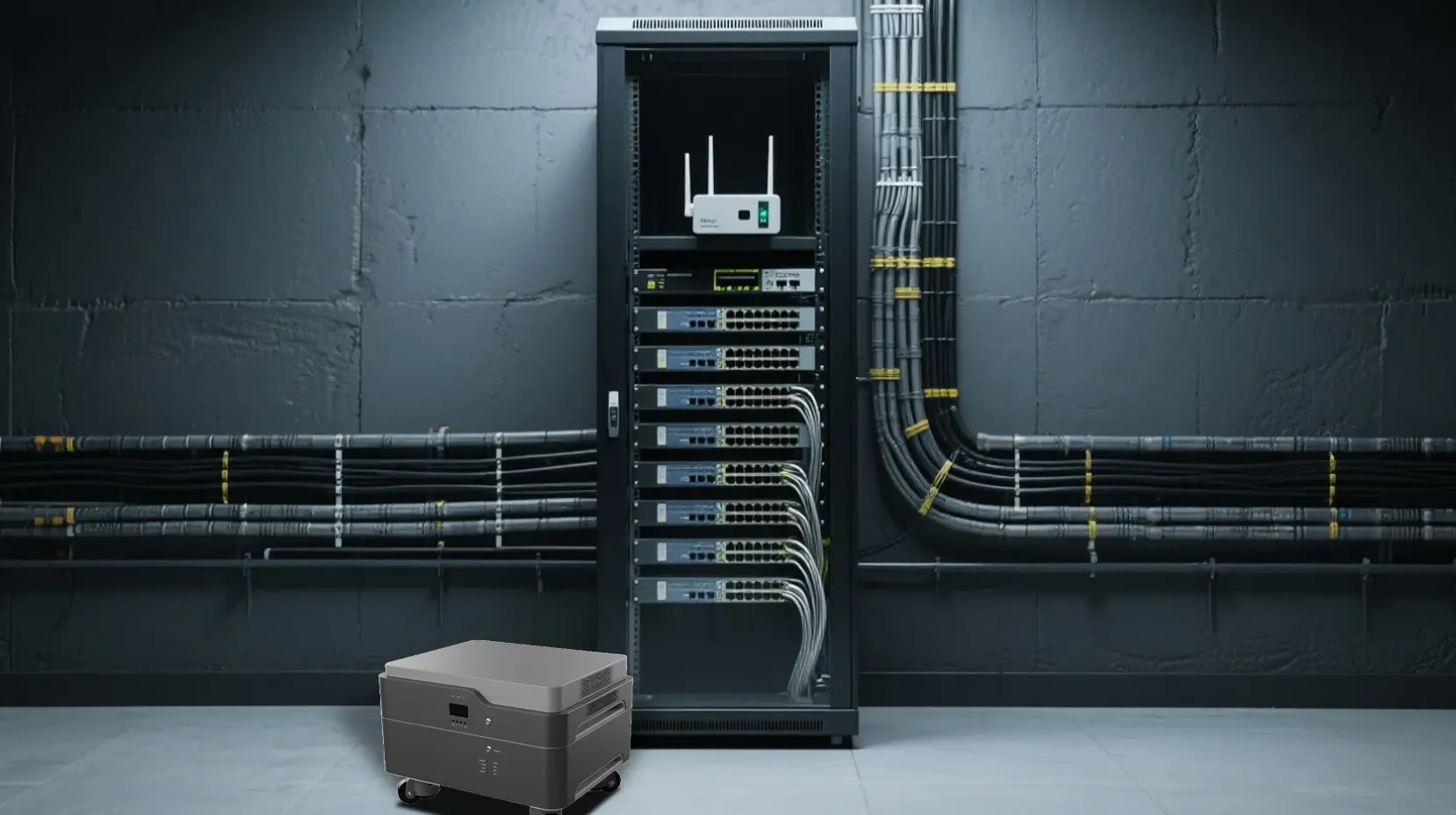
For many branches, your critical IT strip (ATM + router + switch) lands around 300–600 W. That’s our anchor for runtime math below.
Quick sizing: from minutes to hours
Formula you’ll actually use:
Recommended runtime (h) ≈ (Battery kWh × 0.7) ÷ (Load kW)
Why the ×0.7? It’s a simple buffer for conversion losses, temperature, aging, and “real life.”
Runtime look-up (derated with the 0.7 buffer)
Assume two common branch loads.
| Battery Capacity (kWh) | 300 W Load (h) | 600 W Load (h) |
|---|---|---|
| 2.61 | 6.1 | 3.0 |
| 5.22 | 12.2 | 6.1 |
| 7.68 | 17.9 | 9.0 |
| 10.44 | 24.4 | 12.2 |
| 15.36 | 35.8 | 17.9 |
Example: Your measured load is 290 W and you want 2 hours. Required energy ≈ 0.29 kW × 2 h ÷ 0.7 ≈ 0.83 kWh. Even our smallest packs cover that with margin.
Battery choices for banking (LiFePO4 wins)
Why branches favor LiFePO4:
- Safety and stability. Excellent thermal behavior and long cycle life.
- Tighter footprint. Wall-mount or rack options save precious back-room space.
- Fast charge, deep discharge. Recharge between business peaks without drama.
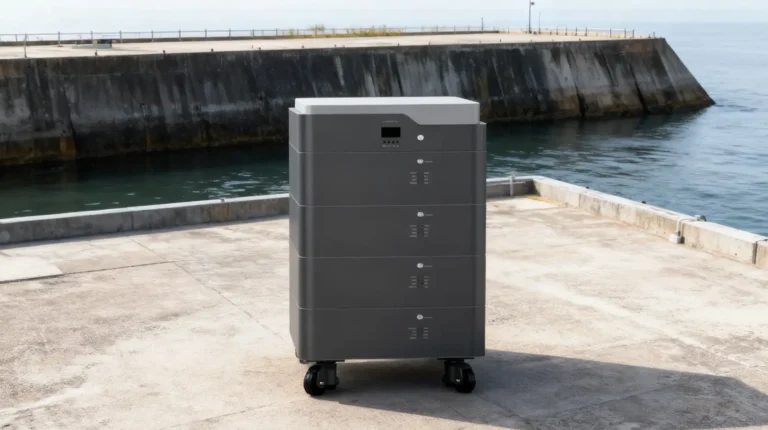
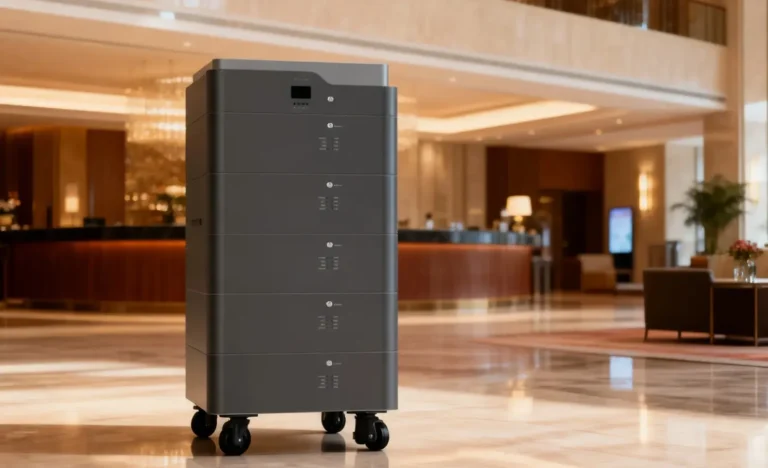
Explore our Backup Battery lineup for banking use cases:
- Category overview: Battery
- 25.6V 5.22kWh Backup Battery (compact workhorse)
- 51.2V 10.44kWh Backup Battery (longer outages, two ATMs)
- 51.2V 15.36kWh Backup Battery (multi-ATM, extended hours)
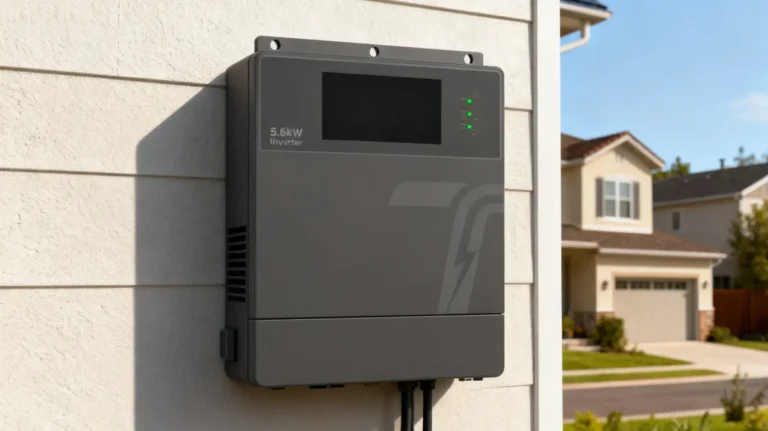
Prefer everything in one cabinet (battery + BMS + inverter + controls)? See our 5kWh stacked all-in-one for modular growth—handy for branches that want a single enclosure with clean cable management.
Actual Branch Cases
Urban outage during peak hours
One downtown branch experienced a sudden 20-minute grid cut just before noon. Two ATMs and the core router stayed online because a 5 kWh lithium battery carried the load. Customers continued withdrawing cash without interruption, and staff completed teller transactions over the network. The outage passed unnoticed by the public.

High-traffic payday
At the start of the month, a branch with three ATMs hit peak demand. Power failed for 45 minutes. A 15 kWh battery bank carried the combined ~600 W load, ensuring all machines stayed open. The queue was long, but no customer walked away due to downtime.
How branches lay out the hardware
Think three blocks:
- Battery pack (LiFePO4) — the energy tank
- Inverter/charger — converts and recharges (yours or integrated)
- BMS + monitoring — protects cells and reports health
Wiring tips:
- Put ATM + router + switch on a dedicated protected circuit.
- Keep DC runs short and labeled.
- Add an isolator and a clearly marked maintenance bypass if your inverter supports it.
- Grounding matters. Noise is the enemy of card readers and modems.
Monitoring and maintenance
- See the state of charge. Tie the system into your NOC or cloud panel.
- Set alerts early. Low-capacity, temperature, and cycle count warnings should page ops well before a failure.
- Test quarterly. Schedule a live discharge test outside business peaks.
- Audit yearly. Confirm cables, lugs, cooling, fire clearance, and labels.
A battery you never test is a battery you can’t trust.
Short buyer’s guide for banking teams
Start with a survey. Measure real loads for ATM, router, switch, LTE backup, and any PoE. Note peaks. Pick your voltage. 25.6V suits smaller sets; 51.2V shines for higher power and better efficiency. Choose kWh with margin. Use the 0.7 derate table above. Decide form factor. Wall-mount vs rack vs stacked all-in-one. Plan growth. Payday peaks? Add a second pack or step up voltage. Lock in monitoring. SOC, temperature, cycles, alarms. Document the runbook. Who gets paged, what they do, and how to fail back cleanly.
FAQs branches actually ask
Will the ATM really run for hours on a battery?
Yes—if you size to measured watts, not to the nameplate. The idle draw is low; the peaks are short. The runtime table shows how much time your kWh buys at both 300 W and 600 W.
Do I need to back up PoE phones and cameras too?
Prioritize ATM, router, and the switch that carries your WAN. Add PoE only if it’s tied to payments, security, or remote access policies.
How do I future-proof?
Choose 51.2V for higher efficiency and put monitoring in from day one. Upsize capacity by ~30% over what the math says—you’ll thank yourself in year three.
What about fire and safety?
Follow local code, keep clearance around the cabinet, and avoid heat pockets. LiFePO4 plus a good BMS is your friend.
Bring it back to what matters
You don’t need a giant system. You need a right-sized battery that keeps the ATM live and the router online until the grid stabilizes. That’s it. Pick a capacity from the table, leave room to grow, wire it clean, and watch it from your NOC.
When it’s time to choose, start here:
- Battery (all models)
- 25.6V 5.22kWh Backup Battery
- 51.2V 10.44kWh Backup Battery
- 51.2V 15.36kWh Backup Battery
- 5kWh Stacked All-in-One
Your ATM keeps dispensing. Your router keeps routing. Your branch stays open.